How to use this checklist
Do the walk-through together with your parent, not behind their back. Ask them to show you how they really use the bathroom: how they enter, how they sit on the toilet, how they bathe, how they get out. Stand outside the door and watch quietly. Many dangers only show up in the real routine, such as holding a towel rail that was never meant to take weight, or leaving the door latched from the inside.
Score each item as fix now, fix soon or fine. Anything that could cause a fall during the next few days, such as a loose tile, a slippery mat or a missing light, goes in the first group. Do the walk-through again after any illness, hospital stay, new medicine or change in how your parent walks, because needs change. If you want a wider view of the whole home, the guide on assessing falls risk at home covers every room.
The floor and the entrance
The floor causes more bathroom falls than anything else.
- Wet and dry zones. Is there a clear line between the wet shower area and the dry area? Water spreading across the whole floor is the usual cause of slips. A shower curtain, a half screen or a simple squeegee habit can help.
- Surface grip. Polished marble, glossy vitrified tiles and glazed ceramic tiles are slick when wet. Test with a wet, bare or socked foot, carefully, while holding a support. If the floor feels like ice, read about non-slip bath mats and anti-slip tape and coatings.
- Threshold. A raised step at the bathroom door, common in Indian homes to stop water escaping, is a trip hazard. Note its height. A shallow ramp or a marked edge may be needed; see portable ramps for thresholds.
- Loose mats. A bathroom rug or a doormat with curled edges has to go. Only mats that stay fixed to the floor should stay.
- Clutter. Buckets, mugs, stools and slippers lying about make a tripping course. Give each thing a fixed place off the floor.
- Footwear. Smooth rubber chappals or bathroom slippers with worn soles are risky. Ask whether your parent wears slippers with a ridged sole and a heel strap, or goes barefoot.
Doors, locks and space
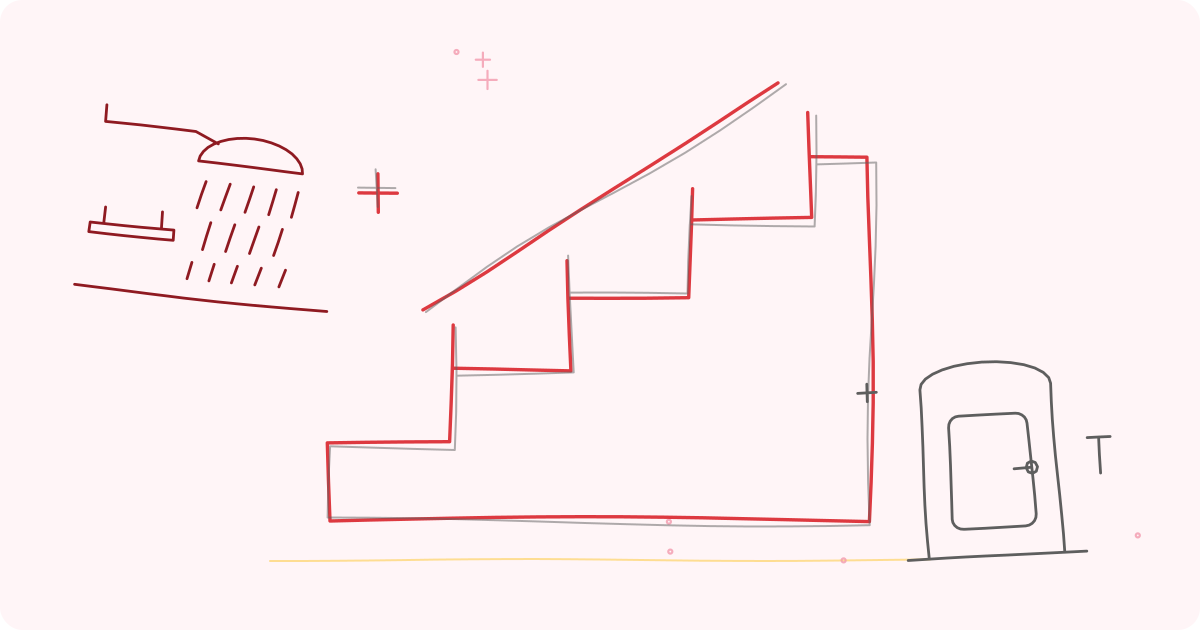
- Door opening direction. A door that opens inward can be blocked by a person who has fallen behind it. An outward-opening door, a sliding door or a door with a lock that can be opened from outside is safer.
- Locks. Replace thumb-turn bolts with a type that a family member can release from the outside with a coin or a key. Some families remove the inside latch and use an "occupied" sign instead.
- Door width. Measure it if a walker or wheelchair may be needed. See bathroom layout for wheelchair and walker users.
- Room to turn. Is there space to turn around and to stand beside the toilet without banging into the basin?
Toilet area
Getting up from a low toilet is hard on stiff knees and hips. Standing up too fast can also drop the blood pressure and cause dizziness.
- Seat height. If your parent pushes hard on their knees to stand, or sits down with a thump, the seat may be too low. A raised toilet seat or toilet safety frame can help.
- Indian-style toilets. If the home has a squat pan, think about whether your parent can still get down and up safely. The guide on adapting an Indian bathroom for knees and hips covers the choices.
- Support. Is there something solid to push on, such as a wall-fixed grab bar or a frame? A towel rail or a toilet paper holder is not a support. See where to fit grab bars.
- Paper and flush within reach. Reaching round awkwardly while seated can tip a person sideways.
Shower and bathing area
- Seating. Does your parent stand to wash? Standing on wet tiles with soapy feet is risky for anyone with weak legs or poor balance. A shower chair or stool removes much of the risk. In homes with a bathtub, a bath transfer bench may be needed.
- Handheld shower. A handheld shower lets a seated person wash without turning or reaching.
- Grab bars. Look for a vertical or angled bar at the shower entrance and a horizontal bar inside. Check each existing bar by pulling it firmly. Any bar that moves is dangerous; read why in suction grab bars are not safe enough.
- Soap and shampoo. Keep them in a caddy at hand height, not on the floor or on a high shelf.
- Buckets and mugs. Many Indian homes use a bucket and mug for bathing. A full bucket is heavy and a stool placed beside it is easy to knock over; lift water with a seated person's reach in mind.
Water temperature
Older skin is thinner and may feel heat late, especially in people with diabetes or nerve damage. A geyser that sends out very hot water can scald in seconds. Check that the geyser has a working thermostat and that the temperature is set moderate, and always mix with cold water so that it is comfortably warm before a parent steps under it. Test with your own hand or a bath thermometer. Our guide on hot water and scald safety explains this in more detail.
Light and visibility
- Night light. Many falls occur on night trips to the toilet. A low, warm light on the path from the bed to the bathroom, ideally a motion-sensor unit, is one of the cheapest safety measures; see motion-sensor night lights.
- Switch position. A switch just inside the door is better than one across the room. Glow-in-the-dark switch plates help.
- Glare and shadow. A single bright bulb above creates shadows. Tiles that are the same colour as the floor and fixtures make edges hard to see for people with poor eyesight. More on this in lighting and contrast at home.
- Spectacles. Is there a safe place to keep glasses within reach, so they are not forgotten before a shower?
Heat, steam and ventilation
A hot, steamy bathroom can cause dizziness and breathlessness. Keep the exhaust fan working, open the window if possible and avoid very long hot showers for people with heart problems or low blood pressure. Damp also encourages mould and slippery algae on tiles, which makes floors even more slippery; see pest, damp and mould at home.
Getting help
- Reach for help. Can your parent call for help from inside the bathroom? A pull cord, a bell, a wrist pendant or a phone kept in a dry place makes sure a fall is not left unnoticed; see calling for help from the bathroom.
- Door habits. Agree that the door is never locked, and that a family member knocks if the person has been inside longer than usual.
- Night routine. For parents who live alone, think about a check-in system; see night safety for a parent alone.
Habits that matter as much as equipment
- Sit down to wash and dress whenever possible.
- Stand up slowly after using the toilet or finishing a bath. Pause for a few seconds before walking.
- Do not carry heavy buckets or a full mug while walking on a wet floor.
- Use a long-handled sponge and a towel with a loop instead of stretching to reach the back or the feet.
- Avoid bathing right after a heavy meal, when very tired or when feeling dizzy or unwell.
- Dry the floor after use with a floor wiper, and wipe spills at once.
Setting priorities and budget
You do not need to fix everything at once. A sensible order for most families is:
1. Remove loose mats and clutter, and improve lighting. 2. Add a night light on the route to the bathroom. 3. Fix at least one properly fixed grab bar at the toilet and one in the shower. 4. Provide a seat for bathing. 5. Improve floor grip. 6. Think about a raised toilet seat or frame. 7. Add an alert system.
Costs vary widely depending on the brand, materials and whether a plumber or mason is needed. The budget bathroom makeover guide shows how to spread the work.
When to ask a professional
Ask your parent's doctor or an occupational therapist to assess the bathroom if your parent has had a fall or near-fall, has recently left hospital, uses a walker or wheelchair, has dementia, Parkinson's disease, stroke weakness or poor eyesight, or avoids bathing because they feel unsafe. A therapist can watch the actual routine and recommend equipment that fits the person and the room. A physiotherapist can work on leg strength and balance, which protects across the whole home. If dizziness, fainting or a sudden change in walking appears, see a doctor first. See occupational therapy home assessment to know what to expect.
Equipment mentioned in this guide
Frequently asked questions
What is the single most useful change to make first?
For most older adults, a properly fixed grab bar and a safe place to sit while bathing bring the biggest reduction in risk, together with removing loose mats and fixing the lighting. Start with whatever matches your parent's biggest difficulty, which you can find by watching their routine.
Is it safe for an older person to bathe alone?
It depends on their balance, memory and general health. Many can bathe alone safely with seating, grab bars and a way to call for help. If your parent has fainting spells, dementia, seizures or severe weakness, someone should be nearby and an assessment is a good idea.
Should the bathroom door be locked?
It is safer if the lock can be opened from outside, or if there is no lock at all. Agree on a knock-and-reply habit. This lets family reach your parent quickly without breaking the door.
How often should I recheck the bathroom?
Every few months, and after any illness, hospital stay or new medicine. Also check grab bars for looseness and mats for wear on a regular basis. The [monthly home safety check](/library/monthly-home-safety-check) gives a simple routine.
Sources and further reading
- World Health Organization, Global report on falls prevention in older age (2007)
- NICE guideline NG249, Falls: prevention, assessment and management in older adults and adults at higher risk
- Centers for Disease Control and Prevention, STEADI initiative: Check for Safety, a home fall prevention checklist for older adults
- Royal College of Occupational Therapists, guidance on living safely at home and home adaptations
Tags: bathroom safety checklistelderly bathroomfall prevention bathroomsenior bathroom safetybathroom modificationhome safetyBathroom and toilet safetyWall-fixed grab barHealthy ageingElder care
This article is for general education and is not medical advice. Speak to your doctor before changing your exercise, diet or medicines.