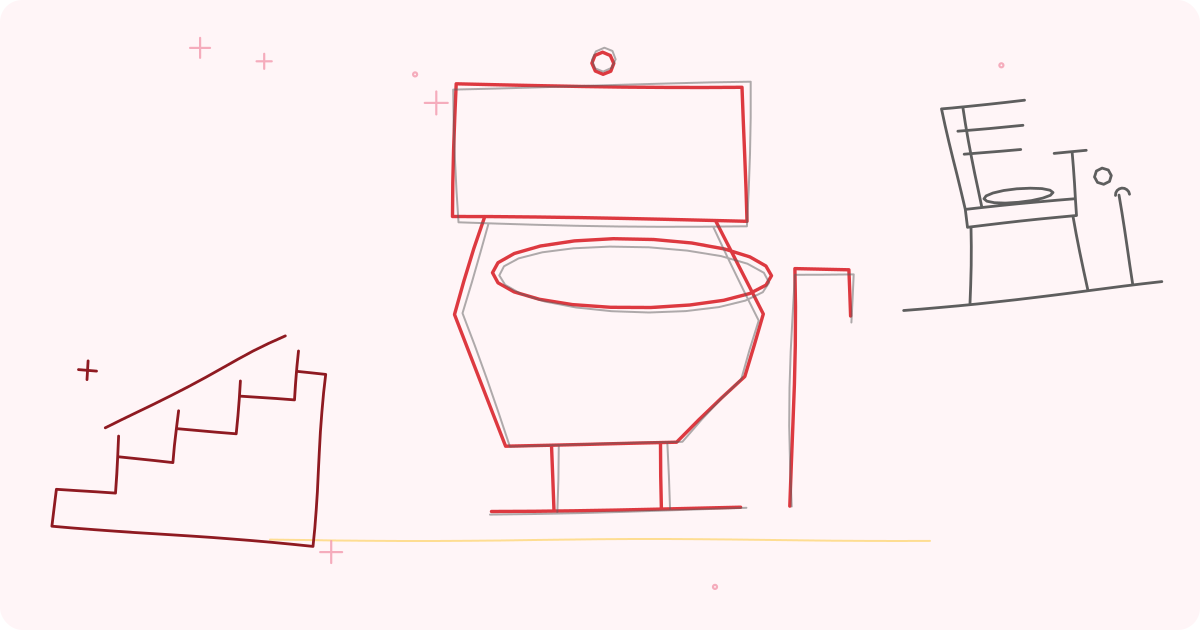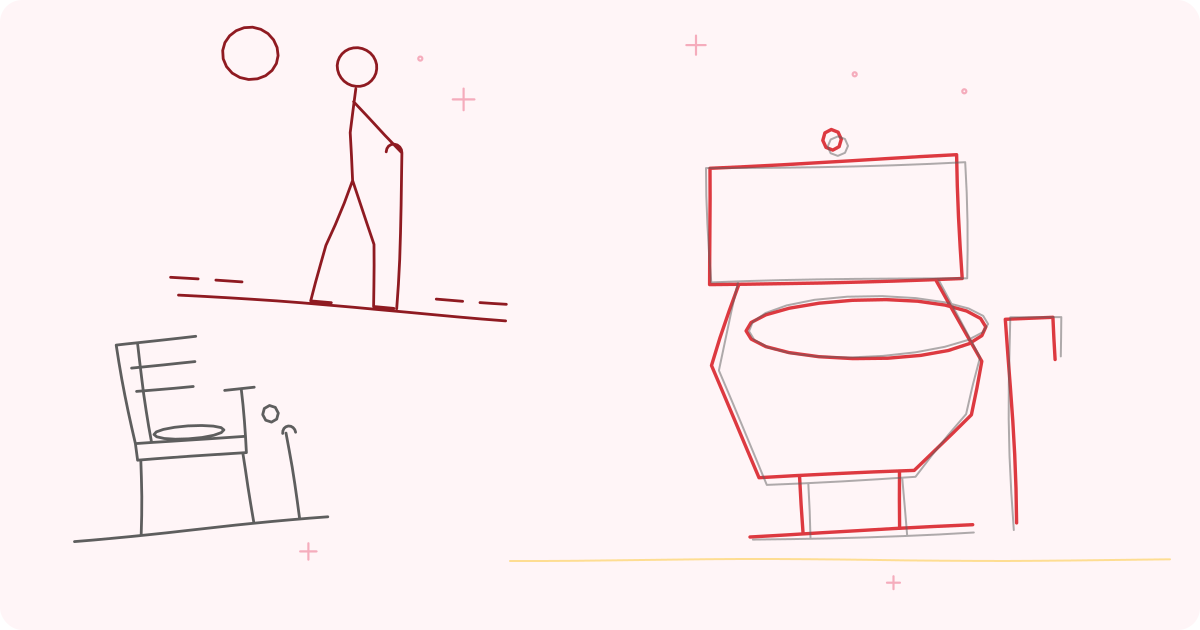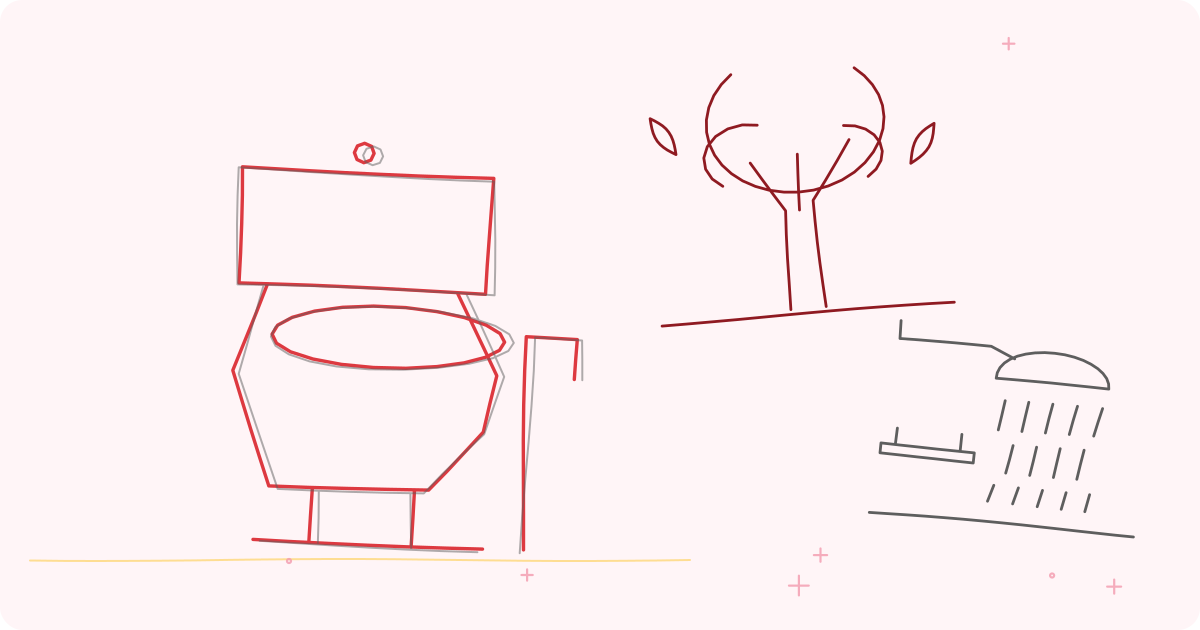
What a toilet frame is
Most frames are made of aluminium or powder-coated steel tubing. A typical frame has:
- Two arms with padded or moulded hand grips, set a little above the toilet seat;
- Four legs that stand on the floor, with rubber ferrules;
- A cross brace at the back or sides to keep the frame rigid;
- Adjustable height legs and sometimes adjustable width.
Some frames are free-standing and surround the toilet. Others clamp to the toilet pan, or combine with a raised seat so the whole unit is one piece. Some have a splash guard or a rear panel; some fold flat for storage or travel. Wall-hung versions with folding arms also exist but fall under grab bars; see the grab bar buying guide.
When a frame is a good choice
- A raised seat has been fitted but your parent still struggles to stand or lower.
- The wall beside the toilet is hollow, tiled over weak plaster or not allowed to be drilled, as in some rented flats. See fitting grab bars in a rented or apartment home.
- Your parent needs support on both sides, perhaps after a hip or knee replacement or because of general weakness.
- The toilet is in a small room with no wall within arm's reach.
- Your parent uses the toilet and needs arms for pushing, but no other fixed support exists.
- The frame needs to be used over a commode or a toilet that varies from room to room.
- You need a portable solution for a recovery period.

When a frame is not the best choice
- Narrow bathrooms. A frame adds width on both sides, and may not fit between the wall and the basin. Measure first. If the door is narrow, a frame can block the way in for a walker.
- When a carer needs access. A frame limits the space for a carer to help from the side.
- For people who need strong pulling. A free-standing frame is good for pushing down but less good for pulling horizontally, because it can tip or slide on a wet floor.
- For squat toilets, where a frame is of little help unless it is part of a structure that fits over the pan; see below.
- For people who find them clinical. Some parents dislike the look. A wall bar may be less obtrusive.
- For those with limited standing ability. If your parent cannot stand at all, a commode chair or other equipment is needed.
Measuring before you buy
Measure the following and write them down:
1. Inside width between the arms. Your parent's hips must fit comfortably between the arms, with room to move. The standard is about 45 to 55 cm. Narrow people may feel safer with narrower frames; broader people need wide ones. 2. Overall width of the frame. Check that it fits between the wall and any adjacent fixture, and that the bathroom door can still close. 3. Arm height above the seat. The arms should be at about 20 to 25 cm above the seat so that the elbows bend comfortably. Arms too high make the shoulders hunch, and arms too low need the user to stoop. 4. Floor to arm height. Many frames adjust in steps. Check the range. 5. Depth of the frame. The legs should not sit under the toilet bowl rim. 6. Space for the cistern. If the cistern is close behind the pan, a frame with a back brace may not fit. 7. Floor. Check it is level. Frames on sloped Indian bathroom floors may need individually adjustable legs.
Features worth looking for
- Weight limit. Choose a frame rated well above your parent's weight, as pushing down on the arms during a stumble places extra force on it. Typical ratings are about 100 to 150 kg.
- Strong, rust-resistant material. Aluminium resists rust in humid bathrooms, while powder-coated steel is stronger but may chip and rust. Check welds and joints.
- Wide, firm rubber feet that grip a wet floor. Check them often.
- Padded or contoured arms. These are kinder to arthritic hands and give a better grip. Check that the grips do not twist.
- Stability. Rock the frame side to side and front to back with firm pressure. It should not move.
- Quick adjustment. Push-button legs are convenient, but ensure the pins are fully engaged on every leg.
- Fold-away arms. One arm that lifts out of the way allows a carer or a wheelchair user to approach from the side.
- A splash guard. Some frames include a panel to keep the person from touching the pan sides; it is a matter of comfort.
- A lid or seat compatibility. Check that the frame does not stop the lid or seat from moving, if you use one.

Setting up the frame
1. Clean and dry the floor around the toilet. 2. Place the frame over the toilet, with the legs flat, and not on the edge of the base of the pan. 3. Set the height so the arms are at the right level for your parent seated, with the elbows slightly bent. 4. Adjust the width so the person's hips fit comfortably. 5. Push the pins fully through the legs, and make sure all four are set the same. 6. Test by pressing down hard on each arm, then rocking the frame. If it moves, readjust. 7. Walk through the routine with your parent: enter, turn, lower, sit, stand and exit.
For a frame that clamps to the toilet, follow the manufacturer's instructions for tightening, and check each time the toilet is cleaned.
Using the frame safely
- Approach the toilet and turn so the backs of your legs touch the seat.
- Reach for both arms and lower slowly.
- Place the feet slightly apart, with the heels back.
- To stand, lean forward, push down on the arms and rise. Pause before releasing the arms.
- Do not use the frame to pull from standing, or as a walking aid. A frame is not designed to be dragged around.
- Do not climb onto it or use it as a shelf.
- Keep a clear floor and a good light; see motion-sensor night lights.
Frames over a commode or a squat pan
Many Indian homes have only a squat toilet, which makes a Western-style frame hard to use. Some options:
- A commode chair with a hole, placed over the squat pan, gives a Western seat and arms in one unit. Check that its legs are on flat floor either side of the pan and that it does not straddle the pan edge. Some are designed for this use.
- A purpose-made frame or stool for squat pans that fits over the pan. Quality varies, so test stability carefully, with weight, before using it.
- A fixed conversion by a plumber, in which the floor pan is replaced by a Western toilet. See squat toilet to Western seat.
Frames also work well over a bedside commode when the commode's own arms are too low or too far apart. Always check the frame's feet are on a firm, level base.
Care and cleaning
- Wipe the frame with warm soapy water and a household disinfectant, paying attention to the grip areas and joints.
- Dry thoroughly, since damp encourages rust and mould.
- Check bolts, pins and feet each month and replace worn rubber ferrules.
- Do not use a bent or cracked frame.
- Clean the floor underneath, where urine and water collect.
When to ask a professional
An occupational therapist can assess your parent's strength and movement, measure for the correct width and height and compare a frame with fixed bars and other solutions. This matters after a stroke, hip or knee replacement, or in Parkinson's disease. A physiotherapist can teach safe standing and sitting. If your parent finds it hard to stand even with arms, has leg weakness that is getting worse or dizziness when rising, see a doctor.
Equipment mentioned in this guide
Frequently asked questions
Can I use a toilet frame without a raised seat?
Yes, if the toilet height is already suitable. The frame gives arms to push on. If your parent still struggles with the seat height, a raised seat can be added.
Are frames safe on wet bathroom floors?
Only when the feet grip well and the floor is level. Check the rubber feet often and keep the floor dry. A frame that slides is not safe.
Can a toilet frame be used with a walker?
Yes, but check there is room for the walker to stand beside it, and that the bathroom door is wide enough. A walker should not be used as a support to sit or stand.
Do frames fit all toilets?
Most fit standard Western toilets, but cistern shape and floor layout vary. Measure width, depth and the space behind the pan before buying.
Sources and further reading
- World Health Organization, World report on ageing and health (2015)
- Royal College of Occupational Therapists, guidance on toilet equipment and home adaptations
- NICE guideline NG249, Falls: prevention, assessment and management in older adults and adults at higher risk
- Centers for Disease Control and Prevention, STEADI initiative materials on home safety
Tags: toilet safety frametoilet surroundtoilet railtoilet armstoilet frame for elderlycommode frameBathroom and toilet safetyHealthy ageingElder care
This article is for general education and is not medical advice. Speak to your doctor before changing your exercise, diet or medicines.