What a quad stick is
A quad stick looks like an ordinary stick with a metal base at the bottom, like a small four-legged stool with a long handle. The four feet are spaced to make a rectangle, each capped with rubber. The shaft usually sits at the back or to one side of the base, so the weight passes through the strongest part of the frame. The shaft is adjustable in height, and the handle is typically an offset or contoured design.
There are two common sizes:
- Small-base quad stick. The base is about the size of a hand. It is lighter and easier to carry, and fits on stairs better, but gives less stability.
- Large-base quad stick. The base is wider and longer. It gives more stability, but is bulkier, heavier and harder to place on stairs and in narrow spaces.
Some quad sticks have a wide base with a slight curve, and many are made so the long side of the base faces the user, which gives more stability in the walking direction.
Who benefits from a quad stick
After a stroke. Weakness on one side can make a single stick unsteady. A quad stick, held in the stronger hand, adds stability and keeps the stick upright when the person reaches for something. Physiotherapists often use a quad stick as a step between a walker and a single stick. See using a quad stick after a stroke.
Moderate unsteadiness or weak balance. If a single stick is not enough and a walker feels like too much, a quad stick can fill the gap.
People who cannot easily bend. Because it stands up on its own, a quad stick is useful for people with back pain, hip replacements or other conditions that make it hard to pick up a fallen stick.
Weakness in the grip. A quad stick is more forgiving if the hand tires, since it remains upright when released briefly.
Recovering from an injury or surgery. Many people use one for a short time as they regain strength.
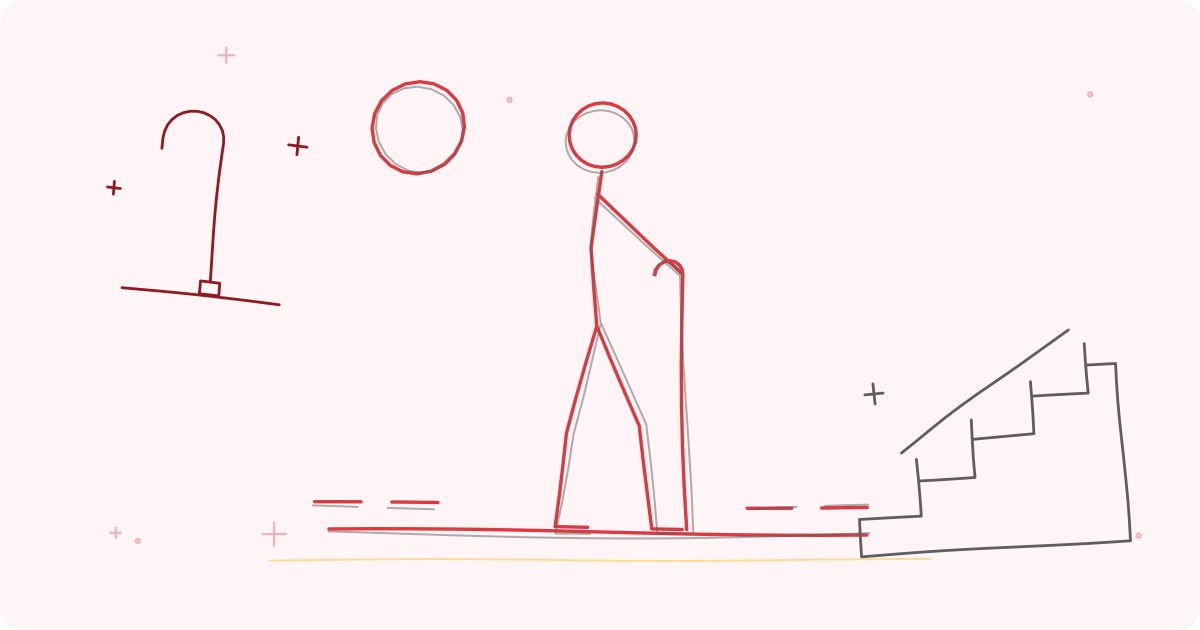
Who should think twice
- Anyone who leans heavily. A quad stick does not take much more load than a single stick; people who lean heavily should consider a walking frame or a rollator.
- People who walk fast or on uneven ground. The wide base can catch on cracks and kerbs.
- Those who need to climb stairs often. A quad stick is awkward on stairs because the base must sit flat on the step.
- People with poor balance on both sides. A two-handed aid is usually safer.
- Anyone who finds the base awkward. Some people trip over the feet or the base when turning.
If you are uncertain, read stick or walker: which one does your parent need, and ask a physiotherapist to assess.
How to choose a quad stick
### Base size
For moderate stability and general use on flat floors, a small base is often the best balance. For stronger support, particularly after a stroke, a large base may be safer, but it takes space and may feel clumsy. Check the base against the width of your doorways and the space in the bathroom.
### Height and fit
Set the height in the same way as for a single stick: the handle at the wrist crease with a 20 to 30 degree bend at the elbow, in normal shoes. See how to measure and set the height of a walking stick. Because of the base, quad sticks are slightly longer than a single stick of the same height setting, so re-check with the base on the floor.
### Which hand
Hold the stick in the hand opposite the weak leg, if the person can hold it, or in the stronger hand after a stroke. The physiotherapist will choose. Make sure the long side of the base faces the right way for the user; many bases are made so the wider part is on the side of the weaker leg or in front.
### The handle
A comfortable offset or contoured handle is essential, because a person who is unsteady leans more. For weak or arthritic hands, choose a thicker or foam grip. See walking stick handles compared.
### The feet
Check that each of the four rubber caps is firm and the same height. If one cap is worn, the stick tilts. Replace all four together. For tips and care, see rubber tips for walking sticks.
### Weight capacity
Check the user weight limit, often 100 to 136 kg, and the quality of the welds and locking button. Cheap quad sticks can flex or wobble.
### Weight of the stick
Quad sticks are heavier than single sticks. A light aluminium one is easier to lift with a weak arm.
How to use a quad stick
Teaching the technique correctly is as important as the choice.
1. Place the stick a short distance ahead of and slightly to the side of the foot, with the base flat on the floor. 2. Step with the weaker leg forward to the level of the stick, or just past it. 3. Bring the stronger leg forward, ahead of the stick. 4. Pause and check balance before the next stride.
Do not tilt the stick. If it tilts, it loses its four-point contact and becomes less stable than a single stick. Do not drag it. Lift it and place it each time, and keep the base flat.
On stairs, follow the rule "up with the good, down with the bad", and where a rail is available, use the rail with one hand and carry the stick, or leave a second stick at the top and bottom of the stairs. See using a walking stick on stairs and slopes. Never use a quad stick on a staircase without a handrail unless a physiotherapist has taught you.
Standing up from a chair: use the chair arms and not the stick, then take hold of the stick.
Turning: take small steps and turn the whole body, not just the shoulders, keeping the stick base on the floor.
Mistakes to avoid
- Using it on soft ground. The feet sink on grass, sand and mud.
- Holding it at an angle. This lifts part of the base and cuts stability.
- Too long a stick. An over-long stick makes the user lean away.
- Worn caps. Even one worn cap changes the height and tilts the stick.
- Using the wrong hand. Ask a physiotherapist.
- Leaving the base on a step edge. The base must sit fully on the step.
Quad sticks in Indian homes
Indian homes often have thresholds between rooms, patterned tiles, rugs and low furniture. A quad stick's base can catch on a threshold or on a rug edge. Remove loose rugs and mark thresholds with contrasting tape. Check that the stick fits in the bathroom entrance, and that it can be placed within reach of the bed and the dining chair. A rubber-footed quad stick is generally better than a bare metal base on polished marble and vitrified tile. Anti-slip tape in the bathroom and kitchen further reduces risk, see anti-slip tape and coatings.
Care and checks
- Check each foot weekly for wear.
- Check that the locking button clicks fully and the shaft does not slip.
- Check the welds and base for bending or cracks.
- Wipe the stick clean after use, especially in the rainy season, and dry it.
- Replace the stick if the base is bent, since a bent base cannot be straightened safely.
When to see a professional
A quad stick should be recommended and fitted by a physiotherapist where possible, particularly after a stroke or surgery. Contact a doctor if your parent has a new fall, sudden weakness, numbness, a change in speech or vision, or dizziness. These can be signs of a new problem, not just a mobility issue.
Equipment mentioned in this guide
Frequently asked questions
Is a quad stick better than a walking stick?
It is more stable because it stands on four feet, but it is heavier and awkward on stairs. It suits people with one-sided weakness or moderate unsteadiness. Those who lean heavily may need a walker.
What is the difference between a small-base and a large-base quad stick?
A small base is lighter and easier on stairs and in narrow spaces but gives less stability. A large base gives more stability but is bulkier and harder to place. A physiotherapist can recommend the right one.
Can a quad stick be used outdoors?
Yes on firm, level surfaces such as pavements and paths. It is not suited to soft ground, gravel or very uneven paths, where a rollator or a pivot-base stick may be better.
Which hand should hold a quad stick after a stroke?
Usually the stronger hand, on the side of the stronger leg or opposite the weak leg, as advised by the physiotherapist. The rule differs from person to person.
How do I know when to stop using a quad stick?
When the physiotherapist finds your parent can walk steadily with a single stick or none. Do not stop on your own, because the risk of falls can rise.
Sources and further reading
- Chartered Society of Physiotherapy, patient information on walking aids
- NICE guideline NG249, Falls: prevention, assessment and management in older adults and adults at higher risk
- Royal College of Physicians, National Clinical Guideline for Stroke (mobility and rehabilitation)
- American Academy of Orthopaedic Surgeons, OrthoInfo: Using a cane, crutches or walker
Tags: quad stickfour-point canestroke walking aidone-sided weaknessmobility aidWalking and mobility aidsQuad (four-point) stickAdjustable walking stickMobility and walking aidsHealthy ageing
This article is for general education and is not medical advice. Speak to your doctor before changing your exercise, diet or medicines.