Principles
- Reduce reaching, bending and lifting. Put what is used most at the easiest height.
- Shorten distances. A compact work area saves steps and energy.
- Make everything visible and reachable.
- Make surfaces safe: non-slip, level, well lit.
- Choose safer appliances, with automatic shut-off.
- Allow sitting. Standing for long periods tires.
- Keep safety systems in place: alarms, fire blanket, phone.
- Respect habits. Keep what works; change what causes difficulty.
For hazards and safe habits, read kitchen safety for older adults.
The work triangle and layout
The cook's main points are the fridge, the sink and the stove. A compact triangle, with the three about 1.2 to 2.7 metres apart, reduces walking. Keep clear worktop between them for putting things down, particularly beside the stove (for hot pans) and the sink.
- Clear walkways of at least 90 cm, wider (120 cm) if a walker or wheelchair is used.
- No clutter on counters or the floor.
- A short route from the fridge to the cooking area.
- A dining space nearby, so food does not have to be carried far.
- A trolley with brakes for moving hot items, if the distance is more than a few steps.
Heights and storage
The comfortable "golden zone" for storage is between hip and shoulder height, roughly 75 to 140 cm from the floor.
- Store heavy items, such as pressure cookers, large pots, bags of rice and atta, between knee and waist height, not on high shelves or on the floor.
- Store everyday items (plates, cups, spices, tea, sugar) within the golden zone, on the counter or in open shelves.
- Store rarely used items high or low, or in a different cupboard.
- Use pull-out drawers or baskets instead of deep shelves, so that items come to you.
- Use lazy Susans (turntables) in corner cupboards.
- Open shelves or glass doors let you see contents.
- Light, easy-to-open lids and containers.
- Large-print labels.
- D-shaped or lever handles on doors and drawers, easier than knobs for arthritic hands.
- Avoid high wall cupboards that need a step stool; if you must, use a reacher and a stable step with a handrail, not a chair; see reachers and grabbers.
Counters, sink and work surfaces
- Counter height: about 85 to 90 cm for standing work, and 70 to 75 cm for seated work. A mix is ideal: a lower section for sitting and chopping.
- Knee space under part of the counter for a seated cook or wheelchair user, at least 70 cm high and 60 cm deep.
- A sink that is not too deep, with a lever tap or a tap turner and a spray; see jar openers and kitchen aids.
- A stool or perching seat with a back and arms, stable and non-slip, at a height that fits the counter, for sitting while preparing food.
- A rolling cart that can be moved to where it is needed.
- A non-slip mat under chopping boards and bowls.
- A pull-out board at seat height, for use as a work surface.
- Rounded edges on counters.
Flooring and mats
- Non-slip, matt flooring that is easy to clean; avoid polished marble, glossy tiles and wet vinyl. Anti-slip treatment can help; see anti-slip tape and coatings.
- Anti-fatigue mat at the stove and sink, securely fixed with no curling edges.
- No loose rugs.
- Wipe spills at once, and keep a cloth in reach.
- Check drainage to avoid pools of water.
Lighting
- Bright, even lighting over the whole kitchen, with task lights under cupboards over counters, sink and stove.
- No glare from shiny surfaces.
- Light switches at the entrance and near the stove, easy to reach, with large rocker switches.
- A night light for night trips to the kitchen.
Cooking appliances
- Induction cooktops with auto-off are safer than open flames for many; they need compatible pans.
- Gas stoves: clear controls at the front, flame-failure safety if available, a regulator switched off after use, a safe cylinder location and a leak check; see smoke and gas safety for older adults.
- Microwave at counter height, not above shoulder height, with large buttons; use microwave-safe containers and watch for steam.
- Rice cooker and electric pressure cooker with auto shut-off, for those who can use them safely.
- Electric kettle with auto-off, or a kettle tipper; see auto-off kettle and stove safety.
- Oven at a comfortable height, with a side-opening door, if possible, and a heat-resistant shelf nearby.
- Fridge with often-used items at waist and shoulder height; a side-by-side or freezer drawer can be easier than a top freezer.
- Extractor fan or open window.
- Timers and smart plugs for forgetful cooks.
Utensils and aids
- Lightweight, two-handled pots and non-stick pans.
- Large-handled, easy-grip utensils; see easy-grip cutlery and eating aids.
- Jar and bottle openers, tin openers and tap turners.
- Chopping boards with spikes and non-slip bases.
- Peelers and graters with comfortable grips.
- Oven gloves with long cuffs.
- A trolley and a basket for carrying.
- A reacher for light items.
- Plastic or lightweight crockery instead of heavy glass or steel for those with weak hands.
- Large-print recipes and labelled spice boxes.
Seated cooking and wheelchair access
For a person who cannot stand for long or uses a wheelchair:
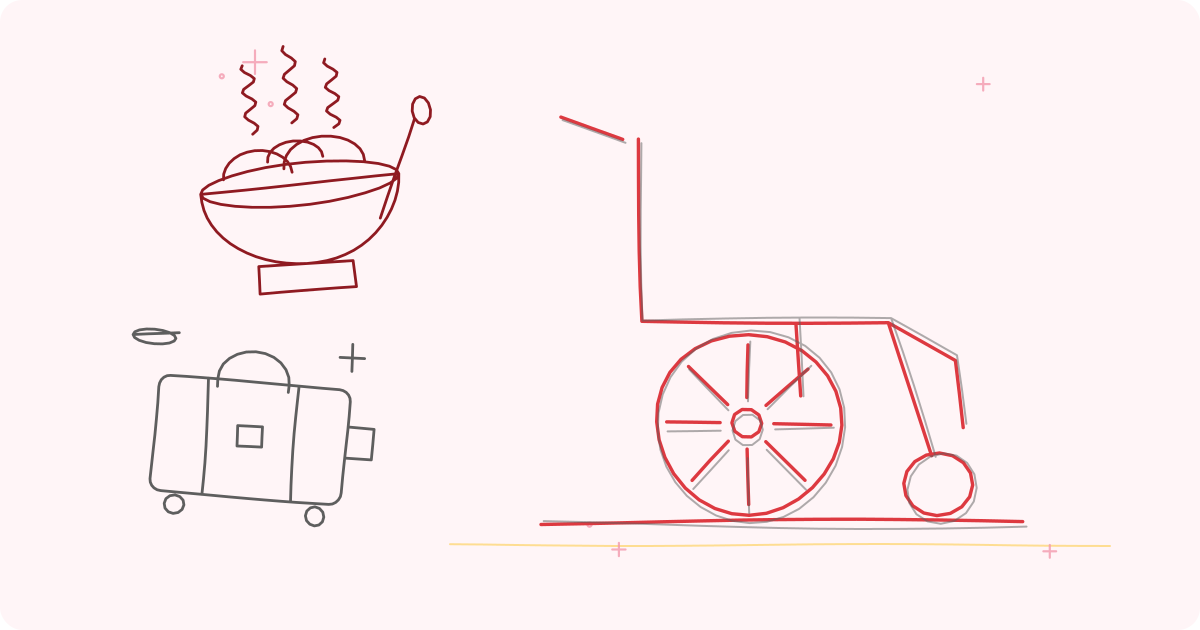
- Clear floor space of at least 150 cm for turning, and 90 cm routes.
- Counter and sink at seated height, with knee clearance, and no cupboards underneath.
- Hob with front controls, at an accessible height, and a mirror or reflective splashback to see into pots.
- Pull-down or lowered shelves.
- A side-opening oven or a microwave at counter height.
- Lightweight pots, a trolley with brakes and rails.
- Lever taps and drawers that open fully with D-handles.
- A well-lit, uncluttered space.
An occupational therapist can advise on specific needs; see occupational therapy home assessment.
Safety systems
- Smoke alarm near the kitchen, and a heat detector if smoke alarms are triggered by cooking.
- Fire blanket within reach and a suitable extinguisher.
- Gas leak detector.
- Residual current device (RCD) for electrical safety.
- First aid kit with burn dressings.
- A phone or alert device within reach.
- Emergency numbers displayed.
Indian kitchen realities
- Floor-level cooking and sitting on the floor. Many older people are used to cooking while sitting on the floor, which becomes unsafe with stiff knees and hips. Encourage a raised platform or a standing or seated work counter. Avoid squatting.
- Tiled floors become slippery with oil and water; use non-slip tiles or mats.
- Heavy steel and cast-iron utensils are hard on weak hands; use lightweight alternatives.
- Oil and spice splashes cause burns; use lids and splatter guards.
- Gas cylinders need good placement and regular checks.
- Joint families share kitchens; agree on rearranging so that an older person's needs are met.
- Storage in high lofts is common; avoid for items used often.
- Heat and humidity make cooking tiring; ventilate and take breaks.
- Ready ingredients such as pre-cut vegetables and ground spices reduce effort; see cooking for one.
A kitchen checklist
- Heavy items at waist height; everyday items within reach.
- Non-slip floor and mats; no loose rugs.
- Bright lighting over work areas.
- Auto-off kettle and safe cooking appliances.
- Lever taps and easy-grip handles.
- A stool with a back for sitting.
- Fire blanket, smoke alarm and gas safety in place.
- A clear path and no clutter.
- Aids in a drawer: jar opener, tap turner, reacher.
- A phone or alert device within reach.
When to ask a professional
An occupational therapist can assess the kitchen and your parent's abilities and recommend changes. A builder or carpenter can adjust storage and heights. An electrician or gas technician should check appliances and installations. Ask a doctor about memory or balance concerns. Our care advisors can arrange a home safety visit and source aids.
Equipment mentioned in this guide
Frequently asked questions
How should a kitchen be arranged for an older person?
Keep the work triangle compact, store heavy items at waist height and everyday items between hip and shoulder, use non-slip floors and bright lighting, choose auto-off appliances and provide a stool with a back.
What counter height is best?
About 85 to 90 cm for standing work and 70 to 75 cm for seated work, ideally with a lower section and knee space.
Is an induction cooktop safer than gas?
Often, for forgetful cooks, because there is no flame and the surface cools quickly, but it needs suitable pans and clear instructions.
How can a wheelchair user use the kitchen?
With clear floor space for turning, counters and sink at seated height with knee space, front controls and accessible storage.
Should my parent stop cooking on the floor?
Usually yes, if knees and hips are stiff or balance is poor. Use a raised platform or a counter at a comfortable height.
Sources and further reading
- Royal College of Occupational Therapists, guidance on kitchen assessment and adaptations
- Disabled Living Foundation (UK), information on kitchen design and equipment
- Bureau of Indian Standards and Ministry of Housing and Urban Affairs, India, accessibility guidance
- World Health Organization, Global age-friendly cities: A guide (2007)
Tags: senior friendly kitchenkitchen layout elderlyaccessible kitchenseated cookingkitchen storage heightsageing in placeSetting up the homeJar and bottle openerDaily living aidsSafety and alert devices
This article is for general education and is not medical advice. Speak to your doctor before changing your exercise, diet or medicines.